
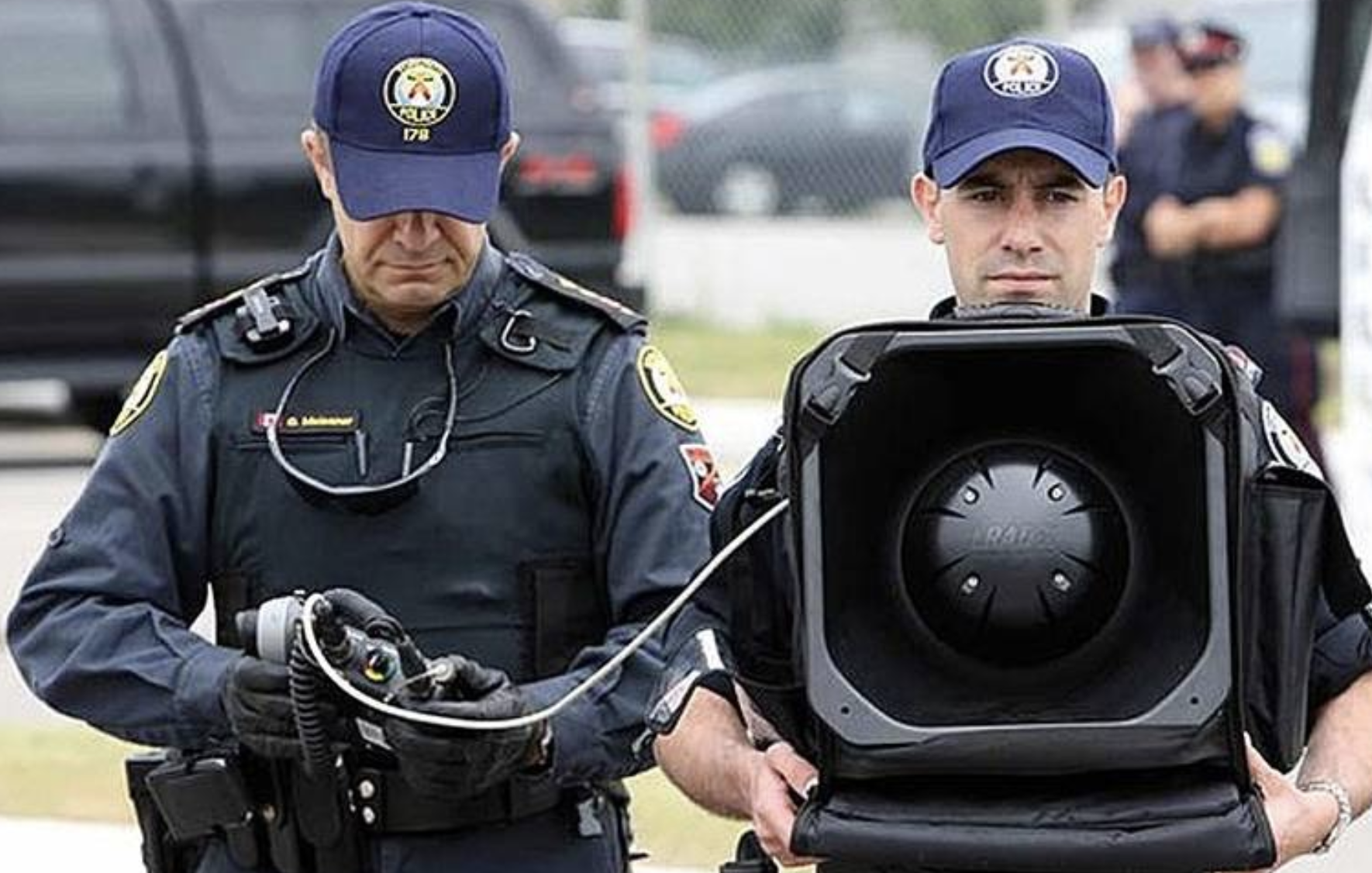
Police officers display a long-range acoustic device used for crowd control at the G20 Summit Pittsburgh protests in September 2009. The LRAD can emit sounds at levels exceeding 140 decibels, loud enough to cause permanent hearing damage and severe pain.
Sonic and ultrasonic weapons are types of weapons that use sound to injure or incapacitate an opponent. Some sonic weapons shoot a focused sound beam to an area, while other sonic weapons generate large fields of sound. The sounds produced by the weapons can cause temporary or permanent loss of hearing to the inner ear, in other words, the cochlea, based on the time spent exposed to the sounds. One may experience the effects of loud sounds in everyday life too. For example, after a large concert, one may experience muffled sounds that were clear before the concert. This is a result of the hairs in your cochlea, which communicate vibrations from sounds to help the brain understand the sounds, being overworked or damaged. The louder and longer the inner ears are exposed to the sounds, the hair cells are bent, and eventually destroyed without return. The role of Sonic weapons is to control the sounds and their frequencies to control the opponent.
Although sonic weapons are a relatively new technology, sound has been used throughout history to threaten opponents and raise the troops’ morale. The war tactics changed when sounds could be used as literal weapons. One of the modern uses of sonic weapons was by the United States military with the “Long Range Acoustic Device”, or LRAD. The weapon was first majorly used during the Iraq war in the mid-2000s, and according to reports, could blast waves of sounds at volumes approaching 150 decibels. This is equivalent to the sound intensity of a firecracker, which has sounds that could quickly damage the ear and cause pain. The LRAD is built to look like a simple speaker and can be used like a megaphone. However, it can also be set to focus a powerful blast of sound on a specific area. What makes the sound so lethal is the intensity, rather than the volume. The LRAD is programmed to operate in the range of sounds the human ear is most sensitive to, which is between 2000 hertz and 4000 hertz. According to audio producer Cory Choy, in an interview with Popular Mechanics, being exposed to the LRAD was like “The sound equivalent of looking into the sun … horrible, nauseating pain.”

A service member operates a long-range acoustic device aboard a military vessel. Military-grade LRADs can transmit sounds up to 162 decibels and communicate across distances of more than five miles.
One beneficial aspect of the technology is to control crowds without having to use physical force. Sonic weapons such as the LRAD have been used against protests that have gotten out of hand. At the 2004 Republican National Convention in New York City, the LRAD was used against Black Lives Matter protesters in Ferguson, New York, and at the protests against the Dakota Access Pipeline in Standing Rock. In both of these protests, the police could use the LRAD to suppress the protest before it became too violent, and before the police had to resort to physical force. Thankfully, the technology is finding its place in common usage by the police around the world. For example, until recently, “the LRAD has been largely nonexistent in the public setting in Australia. The technology was limited to disaster communication during events such as hostage situations” (Carr, 2020). In 2020, during the Black Lives Matter protests in New South Wales, the Australian police deployed the LRAD, which made physical force to control the crowd unnecessary. This sets an example for the future usage of this revolutionary technology.
Leave a Reply